Why Today’s More Fragmented World May Be Encouraging Investors to Think Beyond a Single Country, Currency, or Market.
For decades, globalization encouraged investors to think in increasingly interconnected terms. Capital, supply chains, technology, and investment opportunities flowed across borders more freely than at almost any other time in modern history.
Today, the global landscape is evolving. Strategic competition between major economies, shifting trade relationships, energy security, technological independence, and expanding defence spending are reshaping how governments and businesses allocate capital.
Periods of geopolitical uncertainty naturally create concern. They may also encourage investors to revisit a broader question: How diversified is my portfolio—not only across asset classes, but across countries, currencies, and economic systems?
For internationally active individuals and families, global diversification is rarely about predicting geopolitical outcomes. Instead, it is often about building portfolios that can participate in opportunities across multiple regions while recognizing that economic leadership and investment themes may evolve over time.
Why is the global investment landscape changing?
The world economy is entering a different phase than many investors experienced during the previous three decades.
Governments are placing greater emphasis on energy security, domestic manufacturing, critical infrastructure, semiconductor production, artificial intelligence, cybersecurity, and defence capabilities. Supply chains are being reconsidered, strategic industries are receiving increased investment, and countries are placing greater value on resilience alongside efficiency.
These developments do not necessarily suggest that globalization is ending.
Rather, they may indicate that the next phase of globalization could become more regional, more diversified, and increasingly shaped by national strategic priorities.
For investors, that may create new investment themes across multiple parts of the world.
Does geopolitical uncertainty always mean lower investment opportunities?
Periods of uncertainty are often associated with increased market volatility.
At the same time, history demonstrates that structural change frequently creates new areas of economic growth.
Large-scale investment in infrastructure, technology, energy systems, transportation, digital networks, and industrial capacity has historically required significant private capital alongside public spending.
Rather than viewing geopolitical change solely through the lens of risk, some investors also evaluate how changing government priorities may influence long-term investment opportunities across different sectors and regions.
Future outcomes remain uncertain, and market conditions can change rapidly. Nevertheless, structural transitions may reshape the industries and regions that investors monitor.
Why can international diversification become increasingly relevant?
Many investors naturally exhibit a degree of home-country bias.
Portfolios may become concentrated in:
- one domestic equity market
- one currency
- one economic cycle
- one political environment
- one regulatory system
International diversification does not eliminate investment risk, nor does it guarantee improved returns.
However, allocating assets across multiple countries, currencies, industries, and economic regions may reduce dependence on any single market or jurisdiction while providing exposure to a broader range of global developments.
As different economies respond differently to changing geopolitical conditions, diversification may become an increasingly important component of long-term portfolio construction.
What investment themes are emerging in a more fragmented world?
While no one can predict which sectors will outperform in the future, several long-term themes are receiving increased attention as governments and businesses adapt to evolving geopolitical priorities.
Examples include:
- energy infrastructure
- artificial intelligence
- semiconductor manufacturing
- cybersecurity
- cloud computing
- defence technologies
- logistics and transportation
- industrial automation
- critical minerals
- digital infrastructure
These themes span multiple regions and industries, reinforcing the importance of looking beyond a single domestic market when evaluating long-term investment opportunities.
Why does currency diversification also matter?
Investment diversification extends beyond equities and bonds.
Many internationally active investors also review their exposure to individual currencies.
For example, investors whose assets, income, and future liabilities are concentrated primarily in one currency may evaluate whether broader currency diversification aligns with their long-term financial objectives.
Depending on individual circumstances, this may include exposure to currencies such as:
- Swiss francs
- Euros
- British pounds
- Singapore dollars
- other internationally traded currencies
Currency diversification introduces its own risks, including exchange-rate fluctuations, and should always be considered within the context of an investor’s broader financial circumstances.
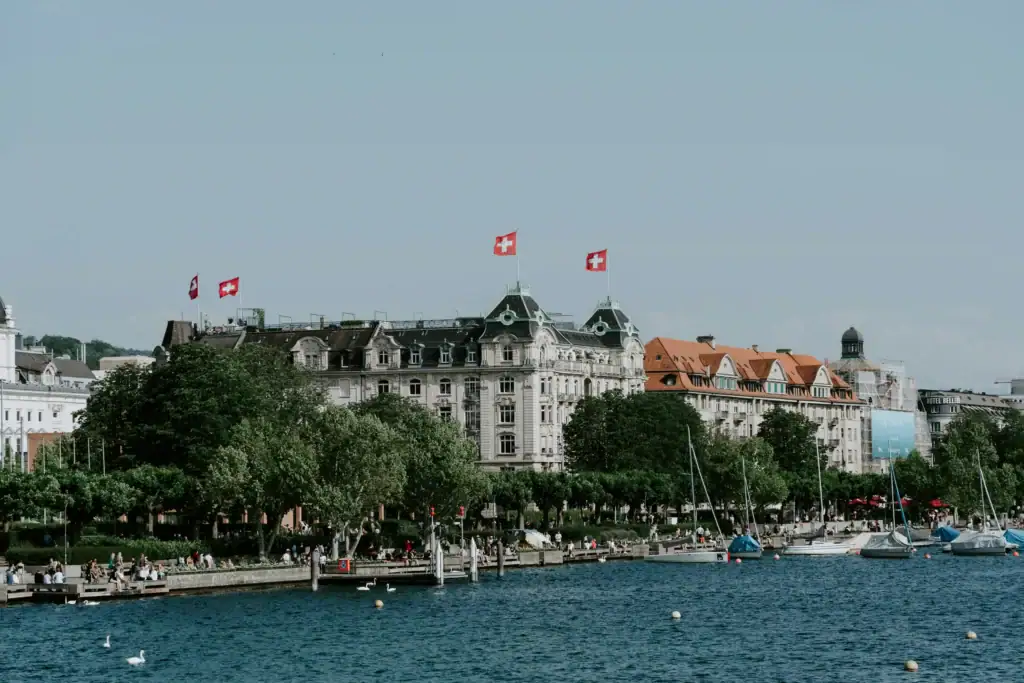
How can Switzerland become part of a global diversification strategy?
For many internationally active investors, Switzerland represents more than simply another investment destination.
Its established banking infrastructure, multi-currency capabilities, political stability, and long history of serving cross-border investors have made it one component of broader international wealth planning for many families.
Depending on individual objectives, Switzerland may play several roles within an internationally diversified strategy, including:
- global portfolio management
- Swiss private banking
- multi-currency custody
- cross-border wealth planning
- international cash management
- jurisdictional diversification
For many investors, Swiss banking complements rather than replaces existing domestic financial relationships.
Why is long-term perspective still important?
- Geopolitical events naturally generate headlines.
- Investment portfolios, however, are often designed with much longer time horizons.
- Over time, economic leadership changes.
- Technological innovation evolves.
- Industries expand and mature.
- Government priorities shift.
- Attempting to predict each geopolitical development can be difficult.
Maintaining a diversified portfolio capable of participating across multiple regions and sectors may provide a more durable framework for many long-term investors than attempting to anticipate every political event.
Frequently Asked Questions
Does international diversification eliminate geopolitical risk?
No. International investing introduces its own risks, including political, economic, regulatory, and currency risks. Diversification does not eliminate risk but may reduce dependence on any single market or jurisdiction.
Why are investors paying more attention to infrastructure and strategic industries?
Many governments are increasing investment in areas such as energy, technology, defence, and critical infrastructure. These long-term policy trends are creating areas of interest for many global investors, although future outcomes remain uncertain.
Should portfolios become less focused on one country?
The appropriate allocation depends on each investor’s objectives, financial circumstances, risk tolerance, and overall investment strategy. Many investors periodically review geographic diversification as part of their broader portfolio management process.
Can Switzerland play a role in internationally diversified portfolios?
Some internationally active investors include Swiss banking relationships, multi-currency portfolios, and global investment management as components of broader international wealth planning. Whether such arrangements are appropriate depends on each investor’s circumstances.
Summary
Geopolitical change has become one of the defining characteristics of today’s investment environment. While uncertainty naturally attracts attention, it also highlights the importance of maintaining perspective.
Rather than attempting to predict geopolitical outcomes, many internationally active investors focus on building portfolios that participate across multiple countries, currencies, industries, and economic cycles.
As governments invest in new infrastructure, strategic technologies, and greater economic resilience, investment opportunities may continue to evolve across regions rather than remaining concentrated in a single market.
For long-term investors, global diversification remains less about forecasting tomorrow’s headlines and more about building a portfolio that recognizes how the world itself continues to change.
About the Author
Alpen Partners International is an independent Swiss-based financial advisor and global wealth planner registered with the US Securities and Exchange Commission as an Investment Adviser. The firm advises internationally active individuals and families on global portfolio management, Swiss private banking, multi-currency strategies, cross-border wealth planning, jurisdictional diversification, succession planning, citizenship and residence planning, and international wealth organization in coordination with qualified legal and tax professionals within applicable regulatory frameworks.
All investments involve certain risks. All investments carry the potential for financial loss, including the loss of the principal amount invested. Past performance is not an indicator of future results.
Market conditions and broader economic factors can significantly impact the value of investments. Investments in international markets are subject to additional risks, such as currency exchange fluctuations, political or economic instability, and variations in accounting practices. Alternative investments, including but not limited to hedge funds, private equity, and real estate, may be illiquid, speculative, and are not suitable for all investors.
The above information should be considered before making any investment decisions.
All posts and publications are for your information only and are not intended as an offer, promotion, or solicitation to buy or sell any financial instrument or perform any other financial transactions. All information and opinions expressed in posts and publications reflect our current views as of the date of the publication and may be liable to change without notice.




 Investment Strategy